






How to Improve Wastewater Recovery Rate Under Energy-Saving and Eco-Friendly Conditions?
Introduction: Why Industrial Wastewater Treatment Matters
As industrialization continues to accelerate, companies face increasing pressure to meet environmental compliance standards while pursuing sustainable growth. Industrial wastewater treatment is no longer just an environmental obligation—it directly affects operating costs, production stability, and resource efficiency.
High-salinity and high-organic-content wastewater is common in industries such as chemicals, pharmaceuticals, electronics, textile dyeing, and electroplating. Traditional evaporation or chemical treatment methods often struggle to achieve all three goals at the same time:
• Energy saving
• Environmental protection
• High water recovery rate
Excessive energy consumption, unstable output, and frequent maintenance all increase operating costs and limit the potential for water reuse.
With years of industrial engineering experience, WTEYA has developed advanced MVR evaporator solutions. Through Mechanical Vapor Recompression technology, secondary steam is recycled and reused, enabling zero liquid discharge while significantly improving water recovery rates. This provides enterprises with a safe, reliable, and sustainable wastewater treatment solution.
Core Challenges in Industrial Wastewater Evaporation
Industrial wastewater evaporation faces multiple challenges that directly affect water recovery efficiency and operating cost.
1. Complex Wastewater Composition
Many industrial wastewater streams contain:
• High salt concentrations
• Organic contaminants
• Heavy metals
• Suspended solids
During evaporation, salts and impurities may deposit on heat transfer surfaces, causing scaling or crystallization. This reduces heat exchange efficiency and may lead to blockages.
2. Fluctuating Water Quality and Flow Rate
Industrial production often causes constant changes in:
• Inlet temperature
• pH level
• Flow rate
• Concentration levels
This requires evaporation systems with highly responsive automatic controls capable of adjusting parameters in real time.
3. Continuous 24/7 Operation Requirements
Most industrial facilities require uninterrupted operation. Frequent shutdowns and startups increase energy use and disrupt downstream production.
For this reason, companies need an evaporation system that combines:
• High recovery rate
• Low energy consumption
•Reliable continuous operation
MVR Evaporator Principle and Technical Advantages
Mechanical Vapor Recompression (MVR) has become a mainstream solution in industrial wastewater treatment due to its closed-loop thermal energy recycling.
How It Works
During evaporation, secondary vapor is generated. Instead of wasting this steam, the MVR system compresses it using a mechanical compressor. The compressed vapor gains higher temperature and pressure, then returns as the heating source for the evaporator.
This creates a self-sustaining thermal cycle.
Key Advantages
Compared with traditional evaporation systems, MVR evaporators can reduce unit energy consumption by 30% to 50%.
Additional benefits include:
Stable and high water recovery rate
• Lower external steam demand
• Reduced carbon emissions
• Intelligent automatic control
• Lower long-term operating cost
This makes MVR technology ideal for companies pursuing green manufacturing and carbon reduction targets.
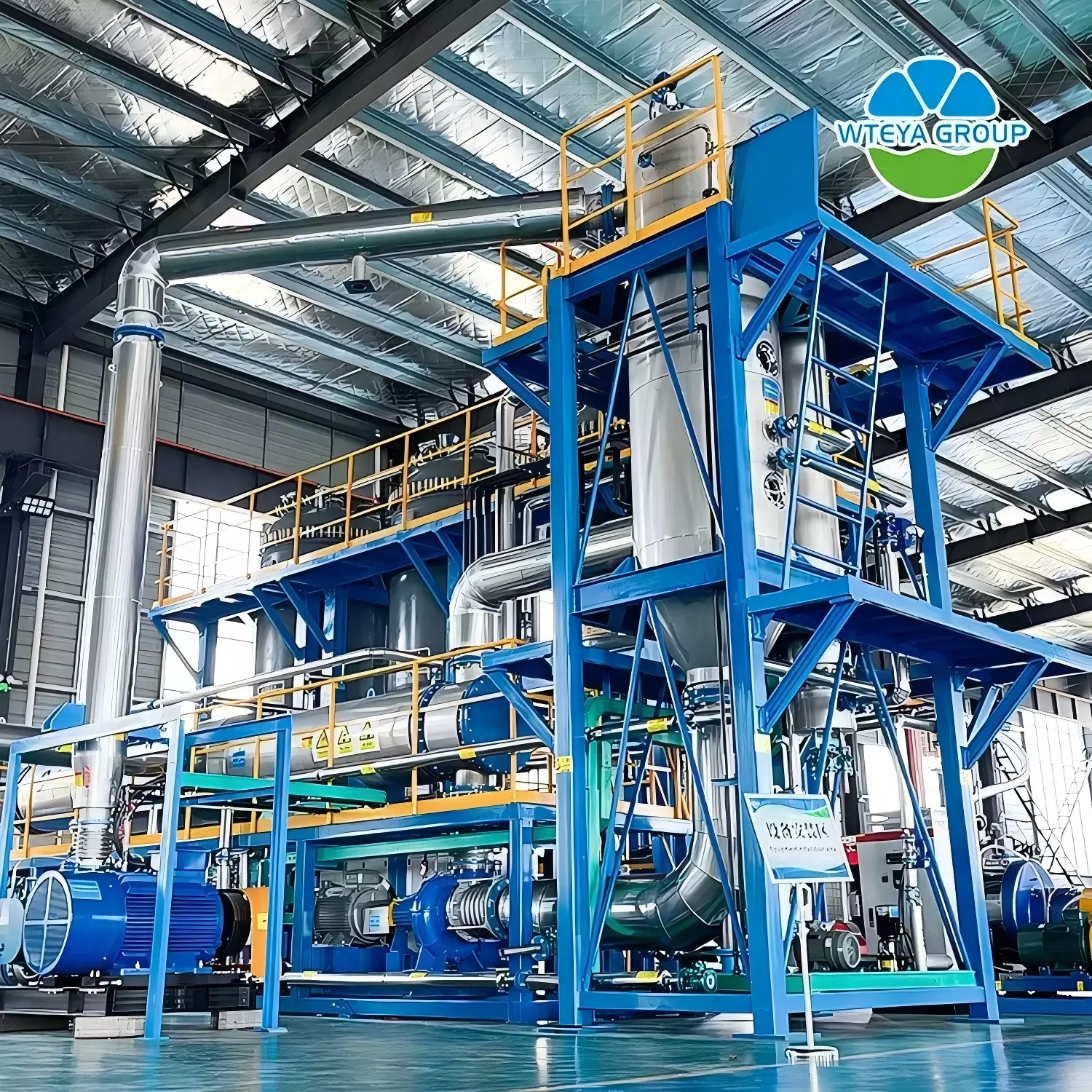
WTEYA MVR Evaporator System Design Highlights
WTEYA provides not just a machine, but a complete industrial wastewater treatment system.
1. Advanced Heater Design
Uniform tube arrangement improves evaporation per square meter while reducing fouling risk.
2. High-Efficiency Separator
Minimizes liquid carryover in steam, protects downstream equipment, and ensures clean condensate water suitable for reuse.
3. Precision Compressor Matching
Accurately matches steam flow and compression ratio for maximum thermal efficiency.
4. Intelligent Control System
Real-time monitoring of:
• Temperature
• Pressure
• Liquid level
• Flow rate
This enables automatic adjustment under varying conditions.
5. Optimized Circulation Pump and Pipeline Design
Ensures even liquid distribution and stable film evaporation, improving system efficiency.
Through integrated engineering, WTEYA systems achieve a balance of:
• Energy saving
• Environmental compliance
• High water recovery
Industry Application Cases
Chemical Industry
Chemical wastewater often contains salts, organics, and heavy metals. WTEYA MVR systems enable zero liquid discharge while reducing external steam consumption by over 30%.
Pharmaceutical Industry
High-purity recovered condensate water can be reused in production, reducing freshwater consumption while meeting GMP and environmental standards.
Electronics Industry
Electronic manufacturing requires high-quality recycled water. WTEYA systems recover purified water while lowering treatment cost.
Textile Dyeing and Electroplating
High-concentration wastewater can be efficiently concentrated, reducing waste volume and downstream disposal pressure.
Strategies to Increase Water Recovery Rate
Improving water recovery is not simply about stronger heating. It depends on complete system optimization.
1. Optimize Liquid Film Distribution
Uniform liquid film prevents local overheating and scaling while increasing evaporation efficiency.
2. Intelligent Automation
Dynamic adjustment of temperature and pressure based on inlet concentration ensures continuous high-performance operation.
3. Compressor and Vacuum Pump Matching
Proper matching maximizes vapor recycling efficiency.
4. System-Wide Coordination
The evaporator, separator, circulation pump, and control system must work as one integrated process.
Energy Saving and Environmental Value
MVR evaporators provide strong sustainability benefits:
• Significant reduction in wastewater volume
• Pollutants concentrated for easier disposal or recovery
• High-purity condensate water reused in production
• Lower total energy consumption
• Reduced carbon emissions
• Resource recovery from wastewater streams
This transforms wastewater from a cost burden into a valuable resource stream.
Conclusion: Choose Proven Technology for High Recovery and Zero Discharge
Achieving a high wastewater recovery rate is not about adding more heat. It depends on:
• Mature system engineering
• Intelligent automation
• Efficient heat recycling
Through:
• Secondary steam reuse
• High-efficiency film evaporation
• Smart control systems
WTEYA MVR evaporators deliver the balance of energy saving, environmental protection, and high water recovery.
For industries such as chemicals, pharmaceuticals, electronics, textile dyeing, and electroplating, WTEYA provides reliable zero-discharge wastewater solutions that reduce operating cost and support sustainable development.
Why Partner with WTEYA?
• Nearly 20 years of industry experience
• Trusted by global leaders including Foxconn, Huawei, Ganfeng Lithium, Ronbay Technology
• 100+ success cases worldwide
• OEM & ODM customization available
Become a WTEYA Distributor!
We are expanding global partnerships:
• Preferential policies
• Professional training
• Full technical support
Let us help you achieve exceptional water quality and operational sustainability!
📲 WhatsApp: +86-1800 2840 855
📧 Email: info@wteya.com
🌐 Website: www.wteya.com